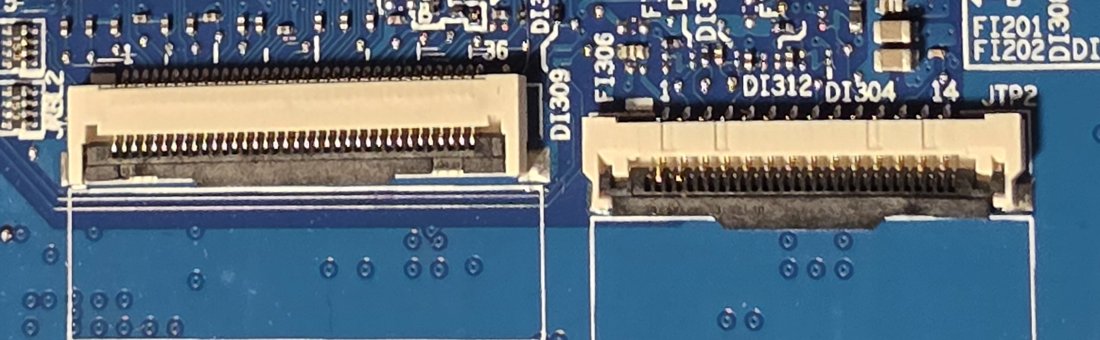
Photo: microscrapping.net
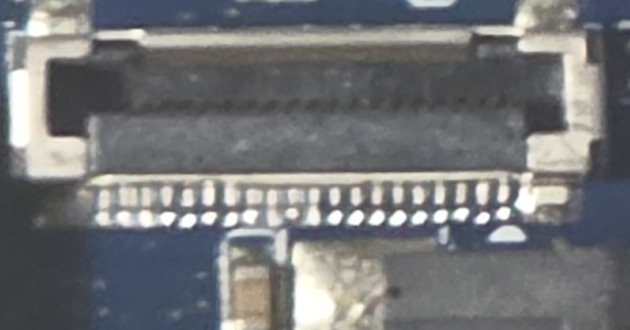
Photo: microscrapping.net
Drawn to true relative scale — the variants above are directly size-comparable.
Gold-Plated Flex Circuits (FFC/FPC/ZIF)
Look at the cable end edge-on under a lamp — recoverable gold sits only on the discrete exposed pads, and if pinkish copper glows through the yellow as you flex it, the gold is immersion flash a tenth the thickness of a mil pin.
How to spot it
Thin amber/orange polyimide or milky-white PET ribbon, 0.1–0.5 mm thick, with 4–120 conductors at 0.3–1.25 mm pitch and a stiffener at each end. ZIF connectors are 1–2 mm tall plastic bodies with a flip-up or slide-out actuator bar. Found on laptops, phones, printers, cameras, disk drives, LCD panels, dashboards and medical scopes.
Metal content
| Metal | Quantity | Notes |
|---|---|---|
| Gold | 0.05–0.15 g/lb of cable | Sub-micron immersion gold, realistically 0.05–0.2 µm, over only 1–3 cm² of exposed pad at each end |
| Copper | ~100 g/lb | Rolled-annealed traces, 15–30% of cable mass |
| Base metal | 60–80% polyimide/PET + acrylic | Refiner-hostile; several reject flex outright |
At 4 Aug 2026 spot prices that works out to $14.1 per lb of contained metal — Gold 0.1 g = $13.1, Copper 100 g = $1.07. A refiner paying $0 per lb returns about 0% of that, which is normal: refining costs money and the buyer takes a margin.
Safe removal
Working temperature: No heat needed; ZIF actuator release
Flip the ZIF actuator up and pull the flex straight out; never yank a latched cable. For scrap, shear the plated end tabs off — the middle of the run is bare copper under film and dilutes the grade badly. The several-micron nickel underlayer is the real chemical obstacle and consumes far more reagent than the gold it covers.
Hazards
NEVER burn boards, wire insulation or plastic. Ever.
NEVER dry-cut boards indoors without extraction.
The practical answer for nearly everyone: sort, concentrate, and sell to a licensed refiner. A good refiner recovers 85–98%, assays rather than guesses, pays on the assay, and takes the waste liability. Your edge as a scrapper is identification and sorting — not chemistry.
Before you scrap it
The common trap
Questions
How much gold is in gold-plated flex circuits (ffc/fpc/zif)?
Gold: 0.05–0.15 g/lb of cable. Copper: ~100 g/lb. At current spot that is about $14.1 of contained metal per pound.
How do you identify gold-plated flex circuits (ffc/fpc/zif)?
Look at the cable end edge-on under a lamp — recoverable gold sits only on the discrete exposed pads , and if pinkish copper glows through the yellow as you flex it, the gold is immersion flash a tenth the thickness of a mil pin.
How do you remove gold-plated flex circuits (ffc/fpc/zif) safely?
Flip the ZIF actuator up and pull the flex straight out; never yank a latched cable. For scrap, shear the plated end tabs off — the middle of the run is bare copper under film and dilutes the grade badly. The several-micron nickel underlayer is the real chemical obstacle and consumes far more reagent than the gold it covers.
Is gold-plated flex circuits (ffc/fpc/zif) worth more working than as scrap?
Yes, and usually the only sensible outcome — 50–300×. Specific FPC cables are repair-critical and unobtainable; a laptop LCD or camera flex sells $5–25 against $0.08 of gold. Photograph the printed part number; scrap only cracked, creased or torn cables.
Related in Contacts & relays
Get this offline → The full guide runs in your browser with no signal, and you can add your own photos.